

Fall Midwater Trawl Survey [FMWT]
Description / purpose
The Fall Midwater Trawl (FMWT) is conducted to determine the relative abundance and distribution of age-0 Striped Bass (Morone saxatilis), Delta Smelt (Hypomesus transpacificus), Longfin Smelt (Spirinchus thaleichthys), American Shad (Alosa sapidissima), Splittail (Pogonichthys macrolepidotus), and Threadfin Shad (Dorosoma petenense) in the San Francisco Estuary (SFE). FMWT has sampled annually since its inception in 1967, with the exceptions of 1974 and 1979, when sampling was not conducted. As of 2023, FMWT samples 130 stations each month from September to December and a subset of these stations are used to calculate an annual abundance index. Of the 130 stations, 35 include an additional zooplankton tow to collect meso- (CB net) and macro-zooplankton (mysid net) samples to inform food availability for young fish. Zooplankton sampling began in 2011. FMWT stations range from San Pablo Bay upstream to Stockton on the San Joaquin River, Hood on the Sacramento River, and the Sacramento Deep Water Ship Channel. Sampling takes approximately 15 days per month to complete.
The FMWT conducts compliance monitoring in collaboration with USBR and DWR to meet permit obligations to the SWRCB (and DRCB) via Water Rights Decisions (D-1485 and D-1641) and USFWS-NMFS biological opinions for Delta Smelt and salmonids, and for incidental take permits issued by CDFW for operation of the State Water Project (SWP), and the USBR BA/ROD. FMWT also informs Natural Resource Agency Delta Smelt Resiliency Strategy management actions including the Suisun Marsh Salinity Control Gate re-operation, the Effects of Outflow Alteration upon Delta Smelt Habitat, Condition, and Survival, and Summer-Fall Habitat Action monitoring.
Project Objectives
• To annually measure the abundance and distribution of selected species of pelagic fishes in the estuary.
• To gain understanding of the factors affecting abundance, distribution, and survival of pelagic fishes in the estuary.
• To detect introductions of new exotic fish and invertebrates.
• Provide baseline data to evaluate management plans and habitat restoration projects.
• To measure availability of fall planktonic food resources.
Linked science activities
None specified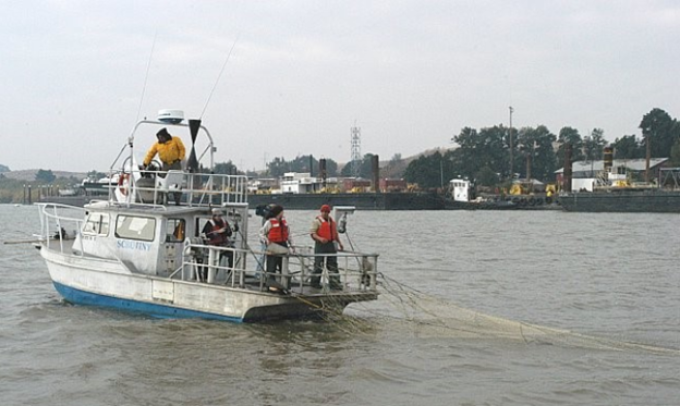
Collaborators
None specifiedActivity status
- 1 Awarded / Initiating (1994)
- 2 In progress / Ongoing (1994 - 2026)
- 3 Complete
Funding summary
Total allocated funding: $0
Location
Geographic tags
Products and outputs
| Type | Title | Description | Views |
|---|---|---|---|

|
Fall Midwater Trawl Survey (FMWT) Data | Links to data for the FMWT | 1 |

|
Fall Midwater Trawl Fact Sheet | Factsheets are concise documents that explain p | 5 |
|
|
Fall Midwater Trawl Bibliography | Annual Fish Abundance Summaries | 2 |
|
|
Fall Midwater Trawl Data Management Plan | Data Management Plans (DMPs) are documents that | 1 |